
Genogram symbols are the standardized visual vocabulary — codified by McGoldrick and Gerson in 1985 — that family therapists, social workers, and medical clinicians use to map a family across generations. This guide covers 150+ genogram symbols across six categories (basic, relational, family structure, emotional, medical, and modern LGBTQ+), plus a free printable PDF cheat sheet and a worked three-generation example you can copy into your case notes.

Do not just memorize symbols — let AI draw them for you. AutoGenogram converts a written family description into a fully labeled, three-generation chart in 60 seconds, with every symbol on this page supported, including modern LGBTQ+ extensions. Try AutoGenogram free →
A genogram is a graphical family tree that records biological relationships, household structure, emotional dynamics, and medical history in one diagram, usually across three generations. The genogram symbols vocabulary was first formalized in Genograms: Assessment and Intervention (McGoldrick, Gerson & Petry, 4th ed., W. W. Norton, 2020), and that 1985 baseline — squares for males, circles for females, horizontal lines for couples, vertical lines for children — is what every clinical training program and electronic health record template still teaches.
The system has not stood still. Recent clinical literature (NIH PMC, 2020) tracks how practitioners have layered new genogram symbols on top of the original set: addiction quartering, abuse line colors, and gender-inclusive shapes for transgender, non-binary, and chosen-family relationships that did not exist in the 1985 manual. A modern set of genogram symbols needs all three layers: the McGoldrick core, the medical/emotional overlays, and the post-2015 inclusivity extensions.
Print this section as the cheat sheet, or skip ahead to download the free PDF chart.
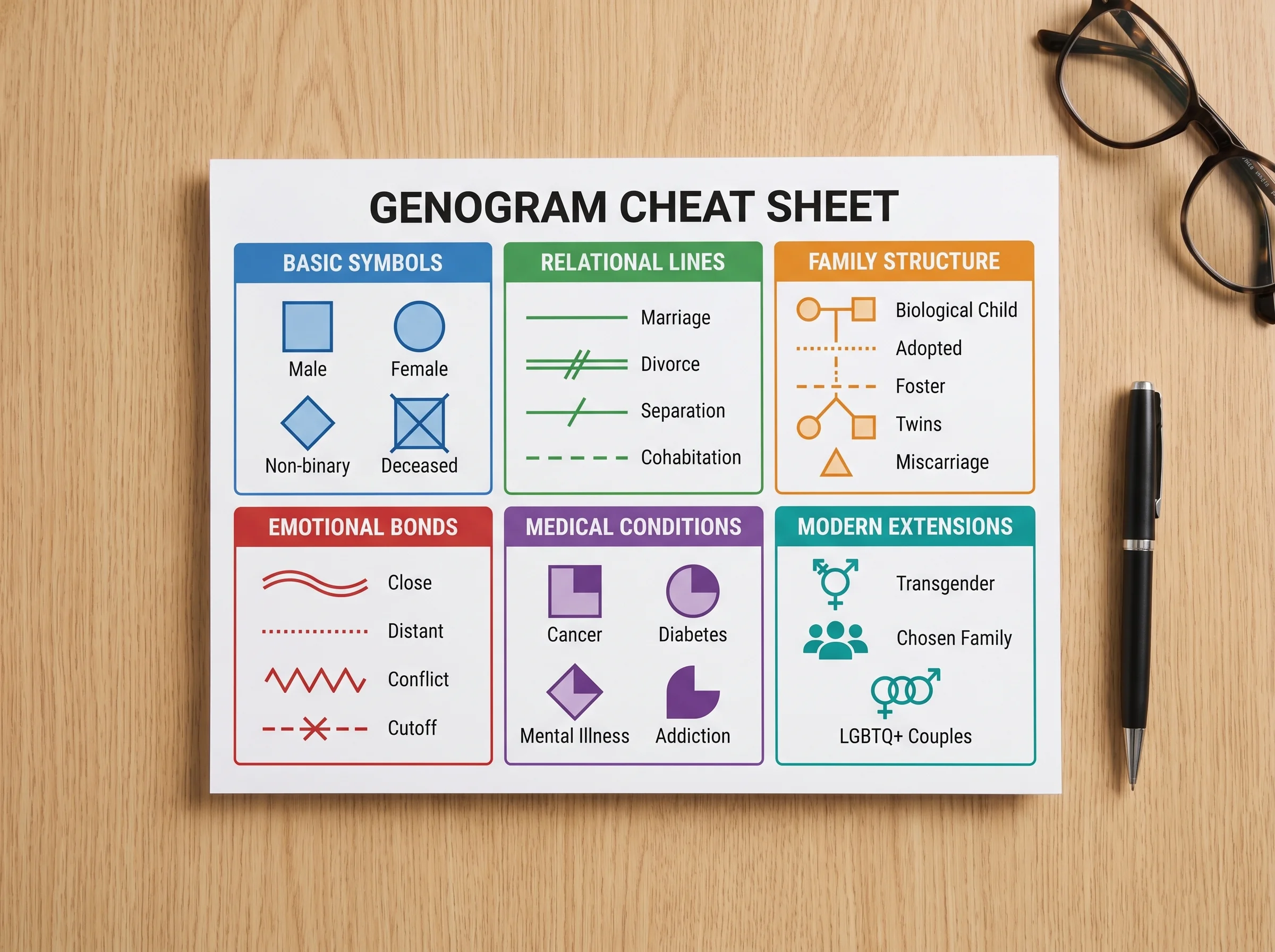
| Symbol | Meaning | Notes |
|---|---|---|
Square ▢ | Male | Place on the left in a couple |
Circle ○ | Female | Place on the right in a couple |
Triangle △ | Pregnancy or unknown-sex child | Use until sex assigned |
Diamond ◇ | Non-binary / gender non-conforming | Adopted from 2017 expansion |
| X through shape | Deceased | Add age at death below |
| Double border | Index person / identified patient | Who you are evaluating |
| Smaller shape | Pet | Increasingly included in family-systems work |
The left-male, right-female placement is non-cosmetic — it is how clinicians scan genogram symbols in seconds. Reversing it makes supervisors misread the diagram.
| Line | Meaning |
|---|---|
| Solid horizontal | Married |
| Dashed horizontal | Cohabiting / not married |
Solid with E above | Engaged |
Single slash / | Separated |
Double slash // | Divorced |
| Wavy or zig-zag | Committed but volatile |
| Reconnected lines with arrow | Reconciliation after split |
Always annotate dates on the line: m. 2014, s. 2019, d. 2021. Dates honor the time order that family-systems theory relies on.
| Symbol | Meaning |
|---|---|
| Vertical line down to child | Biological child |
| Dashed vertical line | Adopted child |
| Dotted vertical line | Foster child |
| Two diagonal lines meeting at a point | Twins (fraternal) |
| Two lines + horizontal bar at top | Identical twins |
| Filled triangle | Miscarriage |
| Triangle with X | Stillbirth |
| Triangle with arrow | Pregnancy (current) |
| Small filled square/circle | Abortion (induced) |
List children oldest-to-youngest, left-to-right under these genogram symbols. The eldest on the left is non-negotiable: birth order is itself diagnostic data in Bowen family-systems work.
These genogram symbols overlay the structural diagram in a second color (often blue or red ink).
| Line | Meaning |
|---|---|
| Single line | Cordial / neutral |
| Two parallel lines | Close |
| Three parallel lines | Enmeshed (fused) |
| Dashed line | Distant |
| Zig-zag line | Conflict |
| Zig-zag overlaid on parallel lines | Conflictual but close |
| Cut line (single bar across) | Estranged / cut-off |
| Single line with arrow toward target | Controlling |
A skilled clinician adds at most six emotional genogram symbols per chart. Past that, the diagram becomes unreadable — distill to the relationships that drive the presenting problem.
This is the most underexplained sub-category of genogram symbols in most online guides; here is the working convention used in social-work supervision and in the Therapist Aid genogram guide (PDF):
| Symbol | Meaning |
|---|---|
| Jagged line with arrow toward victim | Physical abuse |
| Dotted jagged line with arrow | Emotional / psychological abuse |
| Double jagged line with arrow | Sexual abuse |
| Dashed cut-off line | Estrangement following abuse disclosure |
The arrow direction always points from perpetrator to victim, never the reverse. If abuse is bi-directional (e.g., adult intimate-partner violence with mutual physical contact), draw two arrows in opposing directions.
A circle or square is divided into four quadrants. Each quadrant is shaded to record a specific condition, with a legend printed alongside the chart.
| Quadrant fill | Common convention |
|---|---|
| Upper-left, solid black | Cancer |
| Upper-right, hatched | Cardiovascular disease |
| Lower-left, solid red | Addiction / substance use |
| Lower-right, solid blue | Mental illness (depression, anxiety, psychosis) |
There is no universal color standard for medical genogram symbols — every chart needs a printed legend. Treat the four-quadrant frame as standard, colors as locally defined.
This is where most pre-2015 references to genogram symbols — including the still-#1-ranking GenoPro symbols page — fall silent. Contemporary clinical practice has filled the gap:
| Symbol | Meaning |
|---|---|
Diamond ◇ | Non-binary individual |
| Square with circle inside (or circle with square inside) | Transgender (shape = assigned at birth; inner shape = current identity) |
| Two same-shape figures on a horizontal line | Same-sex couple |
| Dotted horizontal line marked "chosen family" | Non-biological kin treated as family |
| Triangle with a + symbol | Donor-conceived child (with donor noted separately) |
| Rectangle with rounded corners | Co-parent outside the romantic dyad |
If your training materials predate 2017, they almost certainly omit these genogram symbols. Use them anyway — WPATH Standards of Care v8 and the AAMFT code of ethics expect clinicians to represent client identity accurately on the chart.
A "3-generational genogram" is the clinical default: grandparents, parents, and the index person plus siblings/children. Three generations is the minimum window for spotting intergenerational repetition — substance use, divorce timing, age at first child.
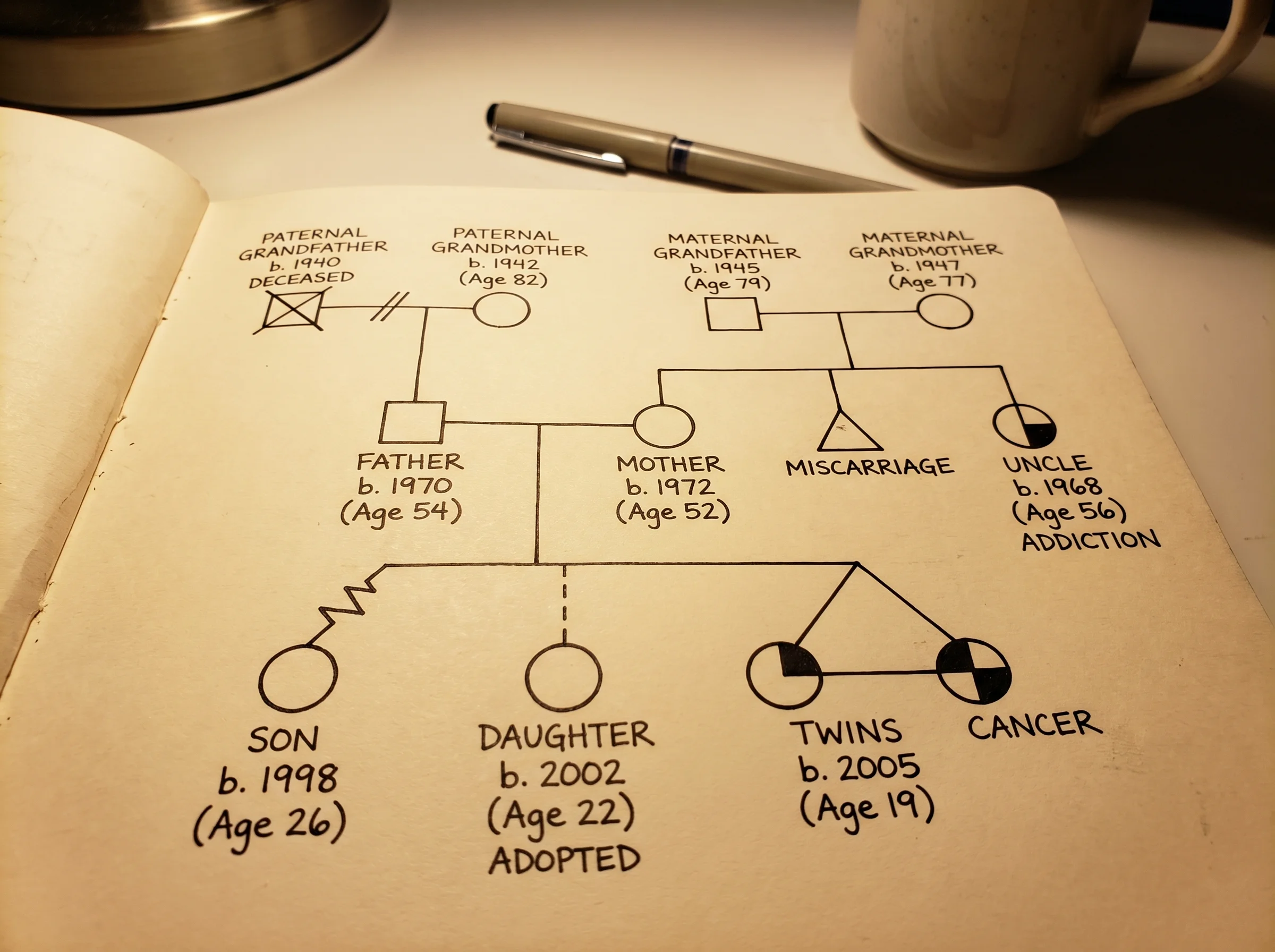
Reading the genogram symbols in the example image, left to right:
In two minutes, a supervising clinician reading these genogram symbols spots substance use one generation up, extended-family pregnancy loss, and an adoption — all context the verbal intake might bury.
These three categories of genogram symbols generate the most "I don't remember the convention" questions in supervision. Step-by-step:
Miscarriage / abortion / stillbirth:
Drawing addiction genogram symbols:
Lower-left filled = addiction (substance + year of onset).recovery YYYY.Drawing abuse genogram symbols:
The single-page PDF cheat sheet below mirrors every table above, organized into the same six categories, printed at A4 / Letter scale so it lives on the wall next to your desk or the back cover of a client file.
Generate your own labeled genogram in under a minute. Once you have the symbols memorized, the bottleneck moves to drawing speed. AutoGenogram takes a typed family description ("Mark, 42, divorced 2019; one adopted daughter Lily, 8; mother died of cancer 2015...") and renders a fully symbol-correct chart in WebP and SVG. Generate your own labeled genogram →
The downloadable PDF contains all 150+ genogram symbols on a single landscape page, the six color-coded category sections, the LGBTQ+ extensions most printable charts omit, and a blank legend box for your local medical-condition color code.
If you memorize only one table, memorize Basic + Relational + Family structure (sections 1-3) — they cover ~80% of real-world genogram symbols charts.
If you would rather skip the sketching loop entirely, AutoGenogram does steps 2–4 automatically from a typed description and lets you tweak the diagram in a visual editor.
Choosing a drawing tool to actually render these genogram symbols? See our 2026 Field Guide of 8 Top Genogram Makers for a benchmarked comparison of GenoPro, Creately, and AI-first options.
What are the basic genogram symbols?
A square represents a male, a circle represents a female, and a diamond represents a non-binary person. Couples are connected by a horizontal line beneath them — solid for married, dashed for cohabiting, with single-slash for separated and double-slash for divorced. Children hang from a vertical line below the couple, listed eldest-to-youngest from left to right. An X through any figure means deceased.
What is a 3-generational genogram?
A 3-generational genogram diagrams three consecutive generations of a family — typically grandparents at the top, parents in the middle, and the index person plus siblings and children at the bottom. Three generations is the clinical minimum for spotting intergenerational patterns such as substance use, divorce timing, age at first birth, or recurring medical conditions. It is the default depth in family-systems therapy and most social-work intake protocols.
What are the symbols for abuse in a genogram?
Abuse is drawn as a jagged horizontal line between perpetrator and victim, with an arrowhead pointing toward the victim. The line style encodes the abuse type: solid jagged = physical abuse, dotted jagged = emotional/psychological abuse, and double jagged = sexual abuse. If the abuse has ended and the relationship is severed, add a perpendicular bar across the jagged line. Always confirm with your supervisor's local convention — color (blue or black) is locally defined.
How do I print a genogram symbols chart?
Download the PDF linked in the "Free genogram symbol PDF chart" section above, print at A4 or US Letter in landscape, and pin it next to the work surface where you take case notes. The chart is single-page by design — multi-page cheat sheets get filed and forgotten.
How do I draw same-sex or transgender symbols on a genogram?
For a same-sex couple, draw two same-shape figures (square-square or circle-circle) connected by a horizontal couple line — the relational conventions (married, cohabiting, etc.) are identical to opposite-sex couples. For a transgender person, draw the shape assigned at birth with the current-identity shape inside it — a square containing a circle, for example, indicates an assigned-male-at-birth person who currently identifies as female. For non-binary, use a diamond. These conventions were formalized after the 4th edition of Genograms: Assessment and Intervention and are not yet on every legacy reference page, but they are now the expected baseline in WPATH-aligned clinical practice.
A genogram is only as useful as its genogram symbols are accurate. Memorize sections 1-3 first, layer in the medical and emotional genogram symbols as you need them, and adopt the LGBTQ+ extensions so your chart represents the actual client in front of you. Print the cheat sheet, keep it on the wall, and the diagram will start to flow.
When the genogram symbols stop being the bottleneck, the drawing tool becomes the bottleneck. Try AutoGenogram free to render the chart in 60 seconds from a typed description — every genogram symbol on this page is supported.
Join the community
Subscribe to our newsletter for the latest news and updates